
Causal Discovery with Hidden Confounders / Identifying Hidden Causal World
In many cases, the common assumption in causal discovery algorithms–no latent confounders–may not hold. For example, in complex systems, it is usually hard to enumerate and measure all task-related variables, so there may exist latent variables that influence multiple measured variables, the ignorance of which may introduce spurious correlations among measured variables. Moreover, there could be complex causal relationships among latent variables as well.
Latent Causal Structure Discovery with Rank Constraints
- Latent Hierarchical Causal Structure Discovery with Rank Constraints. [pdf]
- A Versatile Causal Discovery Framework to Allow Causally-Related Hidden Variables. [pdf]
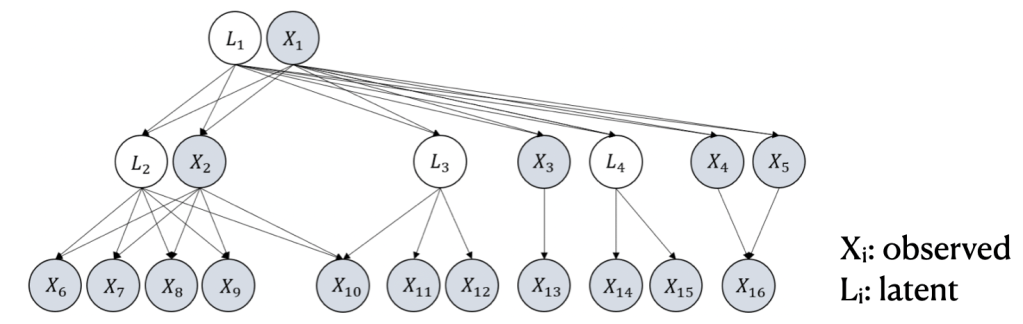
In this work, we introduce a novel, versatile framework for causal discovery that accommodates the presence of causally-related hidden variables almost everywhere in the causal network (for instance, they can be effects of measured variables), based on rank information of covariance matrix over measured variables. We start by investigating the efficacy of rank in comparison to conditional independence and, theoretically, establish necessary and sufficient conditions for the identifiability of certain latent structural patterns. Furthermore, we develop a Rank-based Latent Causal Discovery algorithm, RLCD, that can efficiently locate hidden variables, determine their cardinalities, and discover the entire causal structure over both measured and hidden ones. We also show that, under certain graphical conditions, RLCD correctly identifies the Markov Equivalence Class of the whole latent causal graph asymptotically.

Estimating Latent Variable Causal Graphs with Generalized Independent Noise Condition
- Generalized Independent Noise Condition for Estimating Causal Structure with Latent Variables. [pdf]
- Structural Estimation of Partially Observed Linear Non-Gaussian Acyclic Model: a Practical Approach with Identificability. [pdf]
- Identification of Linear Non-Gaussian Latent Hierarchical Structure. [pdf]
- Generalized Independent Noise Condition for Estimating Linear Non-Gaussian Latent Variable Graphs. [pdf][ code ]
We investigate the challenging task of learning causal structure in the presence of latent variables, including locating latent variables, determining their quantity, and identifying causal relationships among both latent and observed variables. To address this, we propose a Generalized Independent Noise (GIN) condition for linear non-Gaussian acyclic causal models that incorporate latent variables, which establishes the independence between a linear combination of certain measured variables and some other measured variables. Specifically, for two observed random vectors Y and Z, GIN holds if and only if ω⊺Y and Z are statistically independent, where ω is a non-zero parameter vector determined by the cross-covariance between Y and Z. We then give necessary and sufficient graphical criteria of the GIN condition in linear non-Gaussian acyclic causal models. From a graphical perspective, roughly speaking, GIN implies the existence of an exogenous set S relative to the parent set of Y (w.r.t. the causal ordering), such that S d-separates Y from Z. With such a connection between GIN and latent causal structures, we further leverage the proposed GIN condition, together with a well-designed search procedure, to efficiently estimate Linear, Non-Gaussian Latent Hierarchical Models (LiNGLaHs), where latent confounders may also be causally related and may even follow a hierarchical structure. We show that the underlying causal structure of a LiNGLaH is identifiable in light of GIN conditions under mild assumptions.
Identification of Nonlinear Latent Hierarchical Models
In this work, we investigate the identification problem for nonlinear latent hierarchical causal models in which observed variables are generated by a set of causally related latent variables, and some latent variables may not have observed children. We show that the identifiability of both causal structure and latent variables can be achieved under mild assumptions: on causal structures, we allow for the existence of multiple paths between any pair of variables in the graph, which relaxes latent tree assumptions in prior work; on structural functions, we do not make parametric assumptions, thus permitting general nonlinearity and multi-dimensional continuous variables. Specifically, we first develop a basic identification criterion in the form of novel identifiability guarantees for an elementary latent variable model. Leveraging this criterion, we show that both causal structures and latent variables of the hierarchical model can be identified asymptotically by explicitly constructing an estimation procedure. [pdf]
Score-Based Causal Discovery of Latent Variable Causal Models
Many existing works fall under the category of constraint-based methods (with e.g. conditional independence or rank deficiency tests), but they may face empirical challenges such as testing-order dependency, error propagation, and choosing an appropriate significance level. These issues can potentially be mitigated by properly designed score-based methods, such as Greedy Equivalence Search (GES) (Chickering, 2002) in the specific setting without latent variables. Yet, formulating score-based methods with latent variables is highly challenging. In this work, we develop score-based methods that are capable of identifying causal structures containing causally-related latent variables with identifiability guarantees. Specifically, we show that a properly formulated scoring function can achieve score equivalence and consistency for structure learning of latent variable causal models. We further provide a characterization of the degrees of freedom for the marginal over the observed variables under multiple structural assumptions considered in the literature, and accordingly develop both exact and continuous score-based methods. This offers a unified view of several existing constraint-based methods with different structural assumptions. [pdf]
 Biwei Huang